A Complete Buying Guide for Diesel Generator Sets | Selection & Configuration Tips
Selecting a diesel generator set is a systematic project. It is not advisable to make decisions merely based on price and nominal power. Wrong selection may lead to sharply increased operating costs, frequent equipment failures, or even power failure at critical moments. The design and installation of generator sets must be completed by professional engineers, including exhaust backpressure calculation, ventilation calculation, paralleling system commissioning, etc. This article summarizes core selection criteria of diesel generator sets, divided into five main sections and multiple key evaluation dimensions, to help customers build a clear and complete decision-making framework.
1. Clarify Your Core Requirements
1.1 Confirm the Main Application
(1) Prime Power: Used as the main continuous power source for long-time operation, widely applied in remote mining sites and areas with insufficient grid power. You need to select models rated at prime power with sufficient load margin.
(2) Standby Power: Only activated when grid power fails, with limited annual operating hours. Typical scenarios include buildings, hospitals and data centers. Standby power models are adopted, and standby power rating is normally around 10% higher than prime power.
Important Note: Never use a standby-rated generator set for continuous prime power service. It will drastically shorten engine service life.
1.2 Calculate Total Power Capacity
(1) List all loads: Record all powered equipment and their rated power (kW) or rated current (A).
(2) Distinguish load starting characteristics:
- Resistive loads (lights, electric heaters, etc.): Starting current is almost equal to running current.
- Inductive loads (motors, compressors, etc.): Inrush starting current can reach 5–7 times running current, which is the most easily overlooked point in selection.
(3) Total power calculation:
- Steady-state power: Sum of power consumption when all devices run simultaneously.
- Inrush starting power: Calculated by adding the starting inrush current of the largest motor to running current of other equipment.
- Safety margin: Reserve 10%–25% power margin on the calculated maximum total load. Avoid long-term full-load operation and reserve space for future capacity expansion.
1.3 Confirm Site Working Conditions
(1) Ambient temperature: Generator sets need derating under high-temperature environment.
(2) Altitude: The higher the altitude, the thinner the air, and the more severe engine power derating. Normally, power drops by about 3% per 300m rise in altitude. Power correction must be carried out according to altitude.
(3) Installation space: It determines unit dimension, heat dissipation solution and layout, and judges whether a soundproof canopy or mobile trailer is required.
2. Evaluate Technical Specifications & Performance
2.1 Engine
(1) Brand & reputation: Prioritize globally well-known brands (Cummins, Perkins, Volvo, MTU, Deutz, etc.) or their licensed products for stable quality, performance and after-sales support.
(2) Technical types:
- Mechanical pump engine: Mature technology and lower procurement cost, but sensitive to fuel quality with lower emission level.
- Electronic governor engine: Higher governing accuracy and stable output frequency, suitable for loads with strict frequency requirements.
- Electronic fuel injection engine: Precise fuel control, fast response, low emission and energy saving, which is the mainstream solution on the market.
2.2 Alternator
(1) Brand & type: Prefer famous brands including Stamford, Leroy-Somer, Marathon.
(2) Insulation class: Minimum Class H to guarantee stable operation under high temperature.
(3) Protection class: Basic requirement IP23 to resist water droplets and solid foreign objects. Outdoor units are recommended to upgrade to IP54.
2.3 Control System
(1) Basic control: Manual start and basic fault protection.
(2) Automatic control (AMF): Recommended as standard. It can detect grid failure automatically, start the unit and close switch for power supply. When mains power recovers, it switches back to grid and controls unit cool-down shutdown.
(3) Cloud intelligent monitoring: Remotely check unit status, operating parameters and receive fault alarms via 4G/5G/Ethernet, realizing unattended operation and maintenance.
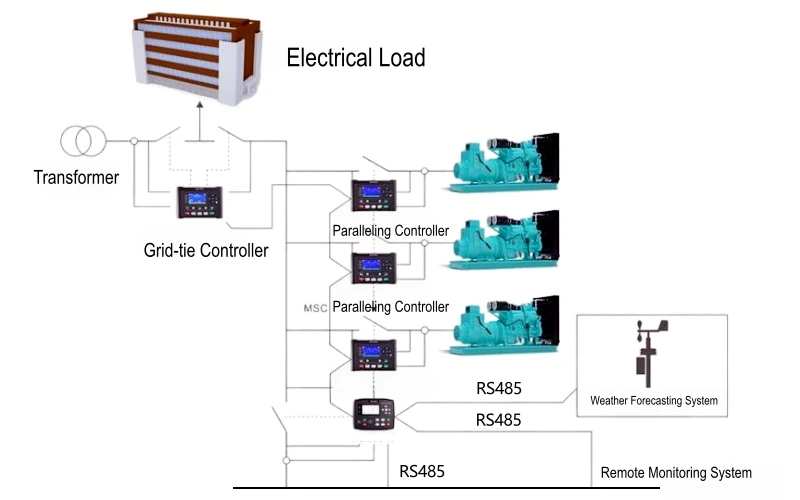
Working Principle of Parallel Power Supply for Diesel Generator Sets
3. Configuration of Each Subsystem
Auxiliary systems of diesel generator sets are the core guarantee for long-term, efficient and stable operation. Poor auxiliary configuration will lead to frequent failures even if the main engine is of good quality. The following introduces configuration points of each auxiliary system in detail.
3.1 Fuel System
Function: Store, deliver and filter fuel to ensure clean and sufficient fuel supply to the engine.
(1) Fuel storage devices:
- Base-mounted fuel tank: Integrated under the unit with limited capacity, generally supporting 4–8h continuous power supply, easy installation. Large projects or long running time require an external fuel tank.
- Large external fuel tank: Customizable volume according to target running duration (24h /48h); equipped with fuel transfer pump to deliver fuel to daily service tank.
- Oil storage tank: Above-ground or underground tank farm for ultra-long continuous operation or strategic fuel reserve.
(2) Fuel delivery & filtration:
- Fuel transfer pump: Mandatory if the tank is installed lower than engine to maintain fuel supply pressure.
- Water-oil separator: Critical component! Separates moisture from fuel and prevents corrosion and damage of fuel injection parts.
- Dual-stage fuel filter: Install extra primary or fine filter before original engine fine filter for double protection and longer filter service life.
- Piping: Use standard seamless copper tube or galvanized steel pipe. Non-metallic pipes are forbidden due to aging and flammability risks.
3.2 Air Intake System
Function: Supply sufficient, clean and cool air for engine combustion.
(1) Air filter:
- Dry-type air filter: Widely used, cartridge needs regular replacement.
- Oil bath air filter: Suitable for heavy dust mining sites with different maintenance routine.
- Filtration efficiency: Choose high-efficiency filter to better protect engine.
(2) Intake pipe: Draw fresh outdoor air. Keep pipeline as short and straight as possible with fewer elbows to reduce airflow resistance.
(3) Intake silencer: Optional for projects with strict noise control in generator room.
Key Point: Air inlet must be placed outside the generator room with good ventilation and low temperature. Do not draw hot air inside the room, otherwise power derating will occur.
3.3 Exhaust System
Function: Efficiently discharge high-temperature exhaust gas and greatly reduce exhaust noise.
(1) Flexible bellows: Mandatory part. Installed after engine exhaust outlet to absorb unit vibration, avoid vibration transmission to flue pipe and prevent weld cracking or equipment damage.
(2) Silencer, classified by noise reduction requirement:
- Industrial silencer: 15–20 dBA noise reduction
- Residential silencer: 20–30 dBA noise reduction
- Super silencer: ≥30–40 dBA noise reduction, for ultra-quiet scenarios
(3) Exhaust pipe:
- Material: High-temperature resistant seamless carbon steel pipe. Ordinary water pipe and galvanized pipe are strictly prohibited (zinc coating releases toxic flue gas under high temperature).
- Slope: Pipe slopes towards engine to avoid condensate water backflow into engine.
- Backpressure: Total backpressure of the whole system (silencer + pipe + elbows) cannot exceed engine manufacturer’s maximum allowable value (usually <5kPa). Increase pipe diameter for long pipelines and many elbows.
- Rain cap: Install rain cap at pipe end to block rainwater and debris.
3.4 Cooling System
Function: Remove heat generated by engine timely and maintain optimal operating temperature range.
(1) Radiator & fan:
- Integrated radiator with fan: Standard configuration for most units. Fan blows backward for heat dissipation. The generator room must have sufficient air inlet and outlet to exhaust hot air.
- Remote radiator: Adopted when unit is installed in closed room and hot air cannot be discharged directly. Radiator is placed outdoors and connected to engine via water pipes.
- Cooling tower: Solution for large units with closed circulating water cooling and better heat dissipation effect.
(2) Coolant: Use qualified antifreeze coolant. Tap water is not allowed to avoid scaling, corrosion and cracking in winter.
3.5 Control System & Electrical Interface
Function: Realize automatic control, condition monitoring, fault protection and safe load connection.
(1) Automatic Transfer Switch (ATS): Core part of standby power system. Continuously monitor grid quality; send start signal to generator set when mains fails, switch load to generator after power quality stabilizes; switch back to grid automatically after mains recovery and control unit cool-down shutdown.
(2) Battery: High-quality starting battery with acid-proof, explosion-proof battery cabinet.
(3) Intelligent charger: Keep battery fully charged to guarantee reliable startup. Charger is powered by mains, and charged by generator when power fails.
(4) Paralleling system: For large projects and N+1 redundant power supply scenarios, paralleling cabinet and synchronous controller are equipped to realize parallel operation of multiple units and unified load distribution.
| Auxiliary System | Core Components | Configuration Points & Purposes |
|---|---|---|
| Fuel System | Daily fuel tank, fuel transfer pump, oil pipe, filter | Ensure continuous, clean and sufficient fuel supply to extend engine service life. |
| Air Intake System | Air filter, silencer, pipeline | Supply sufficient air, reduce intake noise and guarantee combustion efficiency. |
| Exhaust System | Flexible elbow, silencer, exhaust pipe, rain cap | Discharge exhaust gas efficiently, reduce back pressure and noise, prevent rainwater intrusion. |
| Cooling System | Radiator, fan, thermostat, water pump | Maintain engine at optimal operating temperature to avoid overheating shutdown and wear. |
| Exhaust System | Flexible elbow, silencer, exhaust pipe, rain cap | Discharge exhaust gas efficiently, reduce back pressure and noise, prevent rainwater intrusion. |
| Control System | Control panel, battery, charger, ATS | Realize automatic control, monitoring, protection and automatic switching with mains power. |
| Starting System | Battery, battery cabinet, charger | Provide reliable starting power to ensure successful startup at any time. |
| Paralleling System | Paralleling cabinet, synchronous controller | Enable parallel operation of multiple units to meet heavy load or redundancy requirements. |
Conclusion
Do not treat a diesel generator as a single standalone machine, but regard it as a complete power system. Start from your actual site requirements and select suppliers with reliable technology and good after-sales service. Meanwhile, ensure installation, commissioning and later maintenance are implemented by professional teams. Only in this way can the generator set reliably carry loads and supply stable power at critical moments. In addition, auxiliary parameters such as tank capacity, exhaust pipe diameter and ATS current rating must perfectly match main engine power and site conditions. A well-configured auxiliary system can upgrade a diesel generator set from simple machinery into a reliable, intelligent and durable full power solution.
Message us for more information