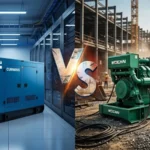
Diesel Generator Troubleshooting Guide: Common Faults & Fixes
05.26.2026
Industrial generator sets are critical for backup power, but like any complex machinery, they can encounter operational issues. This comprehensive troubleshooting guide covers the most common generator faults—categorized into starting problems, running faults, and power output issues—to help you minimize downtime.
I. Generator Starting Problems
1. Battery Failure & Terminal Corrosion
- The Problem: The generator fails to crank, or you only hear a distinct clicking sound when pressing the start button.
- The Cause: A dead or low-charged battery cannot provide enough cold cranking amps (CCA) to the starter motor. Alternatively, heavy corrosion on the battery terminals creates high-resistance connections, restricting critical electrical current.
- The Fix: Inspect battery voltage, clean corroded terminals with a wire brush, and ensure tight connections. Replace the battery if it fails to hold a charge.
2. Fuel System Disruptions
- Clogged Fuel Filters: A filter blocked by debris or contaminants restricts fuel flow. The engine may crank but won’t start because fuel cannot reach the combustion chamber.
- Air in Fuel Lines: If air enters the fuel system, it disrupts the pressurized fuel delivery. In diesel generators, this starves the injectors; in gasoline units, air bubbles prevent the carburetor from achieving the correct air-fuel ratio.
- The Fix: Regularly replace fuel filters and bleed the fuel system to remove trapped air.
3. Starter Motor & Solenoid Malfunction
- Worn Carbon Brushes: Over time, the internal brushes in the starter motor wear down, losing contact with the commutator and breaking the electrical circuit.
- Faulty Starter Solenoid: The solenoid engages the starter motor with the engine’s flywheel. If the solenoid fails, the starter motor will not receive the signal to crank the engine.
- The Fix: Test the solenoid continuity and inspect the starter motor brushes. Rebuild or replace the starter assembly if necessary.
II. Generator Running Faults (While Operating)
1. Engine Overheating
- The Cause: Overheating is typically triggered by cooling system failures:
- Blocked Radiator: Dirt, leaves, or debris clogging the radiator fins, restricting airflow.
- Low Coolant Levels: Coolant leaks that lower fluid levels below the recommended threshold.
- Defective Thermostat: A thermostat stuck closed, preventing coolant from circulating and dissipating heat.
- The Fix: Perform regular radiator cleaning, check for coolant leaks, and replace faulty thermostats immediately to prevent engine seizure.
2. Under-Voltage or Over-Voltage Output
- Under-Voltage: Usually caused by a malfunction in the generator’s excitation system (such as a faulty field winding) or a misconfigured Automatic Voltage Regulator (AVR), resulting in low voltage output.
- Over-Voltage: Typically happens when a faulty AVR fails to limit the voltage, allowing the generator to produce dangerously high spikes that can damage connected electrical equipment.
- The Fix: Inspect the excitation system and calibrate or replace the Automatic Voltage Regulator (AVR).
3. Unusual Noises & Vibrations
- Metallic Knocking: Worn piston rings or excessive clearance between the piston and cylinder wall cause a distinct knocking sound during combustion.
- High-Pitched Squealing: Slipping, loose, or worn-out drive belts that power the alternator or cooling fan.
- The Fix: Tighten or replace loose belts. Internal knocking requires immediate technical inspection to avoid catastrophic engine failure.
III. Output Power & Load Faults
1. Low Power Output
- Clogged Fuel Injectors: In diesel generators, clogged or poorly atomized injectors fail to deliver the precise amount of fuel, dropping engine efficiency.
- Governor Malfunction: If the governor is faulty or incorrectly calibrated, it cannot regulate the engine speed accurately relative to the load, leading to reduced power.
- The Fix: Clean and calibrate fuel injectors, and ensure the engine governor is properly tuned.
2. Voltage and Power Fluctuations
- Sudden Load Changes: When high-demand equipment (like a large electric motor) starts up, it draws a massive inrush current, causing a temporary voltage drop and power fluctuation.
- Internal Winding Short-Circuits: Short circuits or open circuits within the rotor or stator windings create an unstable magnetic field, causing erratic power output.
- The Fix: Manage electrical load distribution using soft starters for large motors, and conduct insulation resistance tests on generator windings.
Request a Quote for Diesel Generator Troubleshooting Guide: Common Faults & Fixes
Tell us your requirements and destination port — we reply with a quotation within 12 hours.
Shall we talk now? You can reach us on WhatsApp.
WhatsApp Us