Off-Grid Diesel Generator Water Pumps for Agriculture: Selection Guide
Off-grid agricultural production demands highly reliable, independent power solutions. In remote croplands, mountainous orchards, and emergency drought relief scenarios, relying on municipal grid extensions is often cost-prohibitive or physically impossible. Integrating heavy-duty diesel generators with high-volume water pumps bridges this infrastructure gap. This technical guide outlines system configuration, hydraulic matching equations, practical field scenarios, and the operational advantages of modern self-propelled irrigation machinery.
I. Core Engineering Components of Off-Grid Irrigation
An optimized diesel-driven pumping system requires matching thermal, electrical, and hydraulic sub-systems to maintain continuous fluid velocity without premature engine fatigue.
| Component Group | Primary Engineering Function | Industrial Selection Baseline |
|---|---|---|
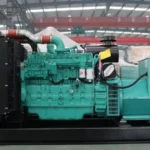
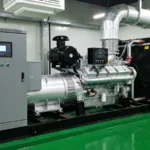
| Diesel Engine / Genset | Converts chemical energy via diesel combustion into mechanical or electrical power for prime continuous duty. | 20-500kW heavy-duty configurations (e.g., Cummins, Weichai, Yuchai engines) configured for variable field loads. |
| Hydraulic Water Pump | Utilizes mechanical torque or electric current to spin industrial impellers, suctioning and pressurizing ground or surface water. | High-efficiency centrifugal or submersible pumps ($Q = 20-1000\text{ m}^3\text{h}$, $H = 10-50\text{ m}$). |
| Electric Control & VFD Box | Regulates startup currents, prevents line phase faults, and protects system internal circuits from electrical shock. | Weatherproof distribution boxes featuring molded case circuit breakers (MCCB) and optional soft-starters. |
| Conveyance Pipeline | Transports volume metrics from the water source directly to terminal field emitters under pressure. | High-density polyethylene (HDPE) or PE lines (DN50-DN300) with reinforced industrial flanges. |
| Fuel Supply Reserve | Ensures long-hour operation during critical crop watering periods without frequent refueling shutdowns. | 20-1000L integrated or external tanks fitted with high-efficiency water-separator filtration. |
II. Technical Matching: Hydraulic Calculations and Sizing
1. Water Pump Power Calculation
Determine the shaft power of the water pump through the formula based on farmland irrigation requirements (flow rate Q, head H):

Parameter Description:
- a. Q: Flow rate (m³/h), determined by irrigation area and water application rate (e.g., 10m³/h per mu of land).
- b. H: Head (m), needing to overcome terrain height + pipeline resistance (empirical formula: actual head = terrain height + 10% pipeline loss).
- c. rho: Water density (1000kg/m³), g: Gravitational acceleration (9.8m/s²).
- d. eta: Water pump efficiency (approximately 70%-85% for centrifugal pumps).
2. Generator Power Matching
- The rated power of the generator P_Generator >= 1.2 x P_Water Pump, as the starting current of the water pump is 3-5 times the rated current, requiring a margin.
- Example:
- a. A farmland requires a flow rate of 50m³/h and a head of 30m, selecting a centrifugal pump (eta=75%):

It needs to be matched with a diesel generator >= 6.5kW (e.g., a 10kW model for sufficient buffer).
3. Pipe and Fitting Selection
- Pipe diameter calculation: Select the pipe diameter D based on the flow rate Q, with the flow velocity controlled at 1.5-2.5m/s, formula:

(v is the flow velocity, m/s)
- Case: When Q=50m³/h and v=2m/s, D is approximately 0.094m, select DN100 (4-inch) PE pipe.
III. Field Scenarios and Structural Configurations
| Irrigation Topology | Environmental Limitations | Recommended Equipment Match | Field Advantages |
|---|---|---|---|
| Mountainous Terraces | Zero grid power, extreme vertical lift, variable terrain contours. | 50-300kW high-capacity diesel genset + high-head centrifugal pump ($H = 40-60\text{ m}$) + integrated drip irrigation lines. | Overcomes severe elevation head drops; saves up to $30\%-50\%$ water volume compared to open flood methods. |
| Large Plain Open Fields | Massive horizontal distances, flat terrain, high volume requirements. | 50-500kW diesel powertrain + large-bore centrifugal suction pump ($Q = 80-100\text{ m}^3/\text{h}$) + overhead impact sprinklers. | Broad territorial coverage; a single industrial configuration efficiently manages 15-35 hectares. |
| Emergency Drought Mitigation | Unpredictable river levels, high asset mobility requirements, rapid setup times. | 30-200kW mobile trailer genset or high-clearance mobile pump truck equipped with lay-flat flexible hoses. | Rapid deployment within hours; highly versatile asset for switching between threatened farm plots. |
IV. Preventive Maintenance and Asset Lifecycle Optimization
Industrial diesel assets working in high-dust agricultural zones require structured maintenance schedules to prevent mechanical downtime during dry seasons.
| Sub-System | Service Interval | Required Field Maintenance | Critical Diagnostic Warnings |
|---|---|---|---|
| Diesel Engine | Every 50 Hours | Verify oil dipstick levels; clean primary air-intake element; inspect belt tension. | Thick exhaust smoke, sudden RPM hunting, metallic valve clicking. |
| Centrifugal Pump | Every 100 Hours | Monitor shaft bearing temperature ($\le 70^\circ\text{C}$); clear impeller debris; check mechanical seal weeping. | High structural vibration, drop in downstream pressure, continuous water packing leaks. |
| Electrical Panel | Monthly | Torque terminal wire lugs; test residual current device (RCD) tripping; blow out field dust accumulation. | Nuisance breaker trips, voltage fluctuations, burnt insulation odor. |
| Fuel Train | Every 200 Hours | Flush low-point tank condensation; change primary 3-stage fuel/water separation filters. | Hard cold-starting, engine surging, unexpected power derating. |
V. Next-Generation Innovation: Crawler-Type Self-Propelled Pumping Units
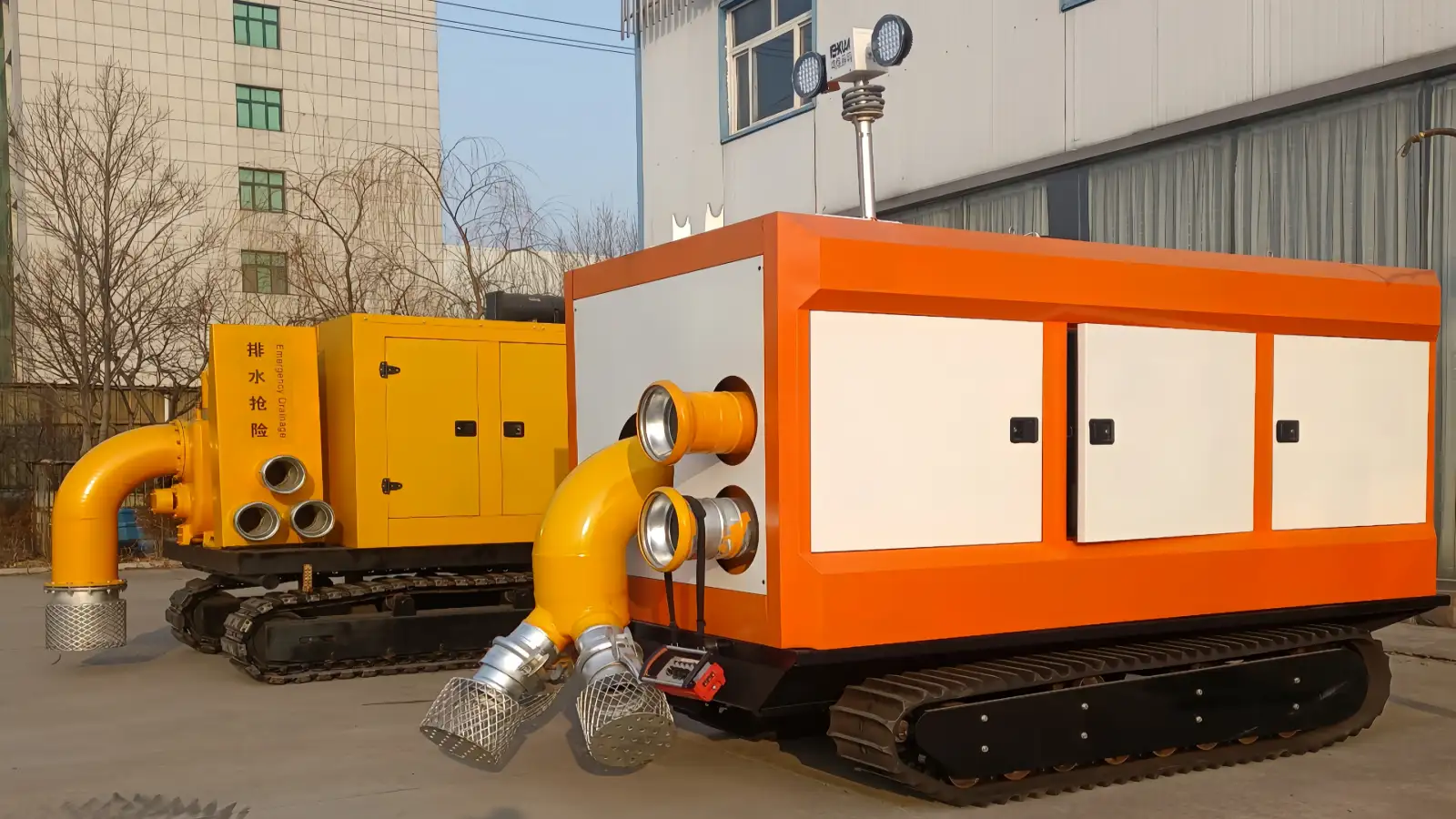
Traditional stationary generator sets restrict irrigation versatility, requiring extensive pipeline networks to cover disconnected fields. To eliminate this logistical bottleneck, Allian Power engineered the Crawler-Type Self-Propelled Generator and Pumping Unit.
This system integrates a high-torque diesel generator set and a commercial-grade water pump directly onto a heavy-duty tracked crawler chassis. Utilizing its high-clearance, cross-country track design, the self-propelled machine traverses mud, steep slopes, and soft agricultural soils effortlessly. By eliminating the reliance on fixed towing infrastructure or concrete pads, operators can move the pump intake directly along natural canals, rivers, or temporary reservoirs. This mobility reduces main pipeline investment, shortens setup times, and offers unprecedented drought-response capabilities for large-scale agricultural enterprises.
VI. Technical Advantages of Our Company
Allian power has newly developed a crawler-type self-propelled generator set water pump. This unit is an integrated agricultural irrigation equipment that uses a crawler chassis as a mobile carrier, equipped with a diesel generator set and a water pump system. It drives the water pump to pump water through the diesel generator, has cross-country walking capabilities, can flexibly shuttle through fields, does not rely on fixed power supplies, is suitable for mobile irrigation in water-scarce farmland, can quickly respond to the irrigation needs of different plots, and improves agricultural drought resistance efficiency.